

 Dec 26, 2025
 3 min read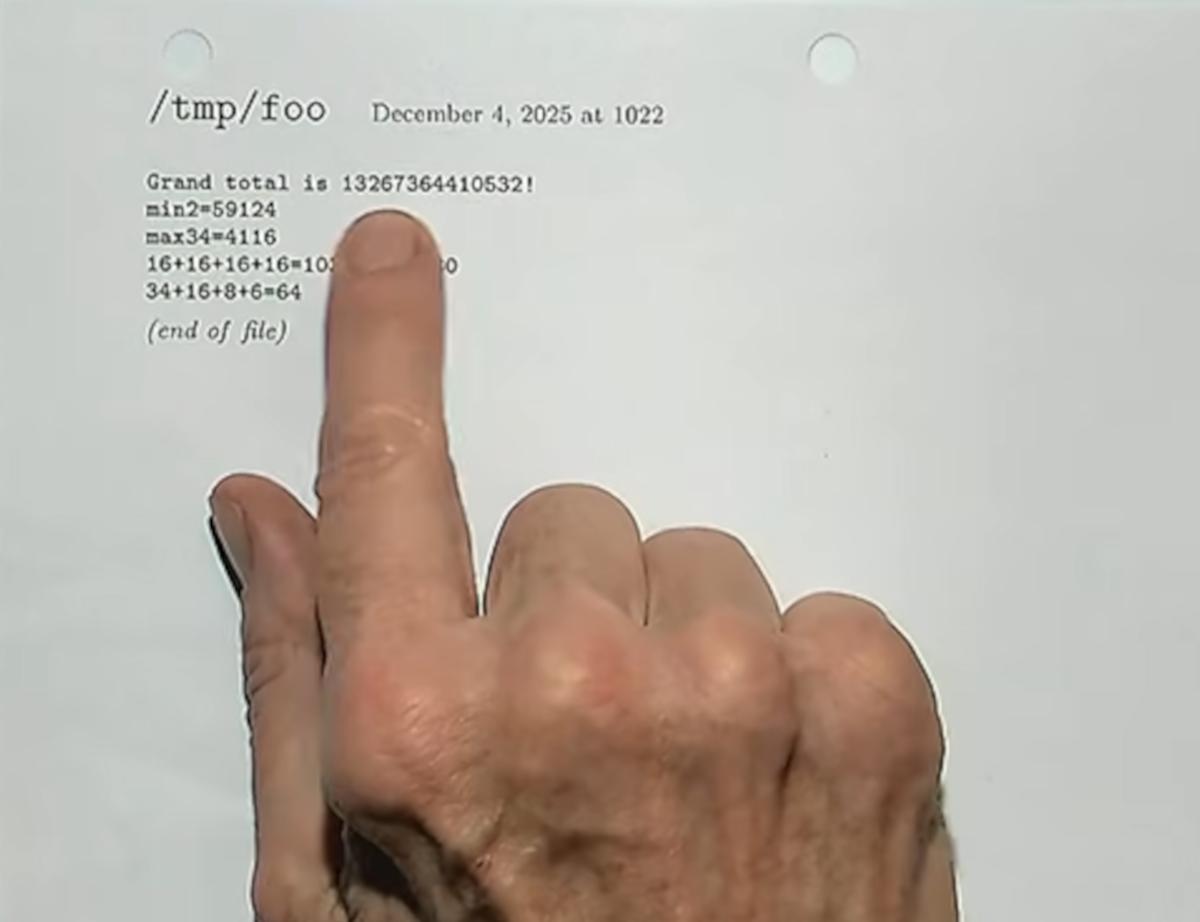
This year, Knuth digressed to share his latest progress in sorting and counting the trillions of ways a knight can access each square on the chessboard.
Donald Knuth Christmas Lecture 2025: The Knight's Tours
"It's that time of year!"read the letter from Stanford Online.Approaching his 88th birthday, Donald Knuth returned in early December to his special once-a-year "Christmas" lecture, a tradition he has honored for more than 30 years.
The beloved Stanford professor reminded his audience that he is still writing The Art of Computer Programming - the legendary book he has been working on for more than 63 years (which he has published in installments).
But this year he took a different approach: the respected mathematician and algorithm expert promised to discuss "the latest advances in one of the most valuable graphical questions that has fascinated people for more than 1,200 years: 'Can a knight cover all the squares on a chessboard without ever visiting the same place twice?'
Yet, within the dazzling permutations of this question, Knuth taught an important life lesson—that through all the math and computer science, beauty is what he's looking for.Gleefully flipping through his printouts, Knut showed off his favorite puzzle solutions, such as a collection of precious snowflakes.
And with warmth and intelligence, they delivered a truly celebratory moment.
Art and adventure
Speaking in Stanford's Nvidia Auditorium, the conference opened with an announcement: Recordings of past lectures have recently been restored!They also created a playlist of 26 Christmas lessons dating back to the late 1990s;Knuth's own web page links to other video collections from 1981.
But looking ahead to 2025, Knuth jokingly told his listeners: “I have to act quickly tonight because I’ve had too many adventures this year.”First of all, Knuth's "News" page says that he celebrated his 64th wedding anniversary in June.
In April, he also helped reopen the computer science department at All Western University in Cleveland.When they asked Knuth how to decorate its walls, Knuth suggested a "knight's journey"—consisting of tracing the path of a knight visiting each square of the chessboard once.
Knuth also collaborated with his alma mater's design team to explain the math depicted on each wall, in a new 2,200-word page on his website.Knuth's website calls it “an exciting prospect for me, as I've long been a fan of 'geek art'” — a concept Knuth explained in his Christmas lecture.
He is described in detail in "The Art of Computer Programming".And he shares examples in this Christmas lecture.
Knuth said his passion for Knight's Tours began in 1973, and more than half a century later, he finally discovered his old record.
But Knuth also noticed that every combination of two moves in a Knight's Tour would form an angle or "corner" - and it turned out that identifying the angles formed when landing on the four middle squares "gives me an easy way to divide all the Knight's Tours into about one-eighth of the number."(Since each solution can be rotated in all four directions or flipped to its mirror image.)
Here's an important lesson: what you can classify, you can measure.
Here in the 21st century, Knuth wrote a program to do such "counts" - to calculate the number of total solutions (given specific sets of wedge shapes for those four middle squares).The final preliminary chapters of his book (the published draft) detail what he calls the "funny" data structures he used, allowing him to finally answer the fateful question first posed in 1891: how many solutions do 16 moves have for each of the four possible mathematical slopes of the horse's moves?
Answer: 103 361 771 080.
"They weren't that hard to find. But they weren't that easy to make by hand!"
Later, Knuth says that he hears from "different people who are passionate about this topic... It's kind of right - I don't know, the pure beauty of some of these trips, to watch. It's like listening to some of your favorite music - it rhymes somehow."
During the question and answer session, Knuth told the audience that the mathematician created a night tour for a three-dimensional chess (with four squares on each side)."It has a beautiful symmetry."
Soon he presented an interesting result - the total number of solutions to the Knight's Journey problem: 13,267,364,410,532.
"This is the number I thought I would never know the answer to when I was a schoolboy."(The number was first calculated in 1997 by Australian mathematician Brendan McKay.)
All of this is explained in "Computer Programming Techniques: Pre-Fascicle 8a (Hamilton Paths and Loops)".But that's just the beginning.If you draw two lines connecting the three squares where the knight lands, you'll naturally get an angle, and "many people are competing to see which knight's tour has the most 37-degree angle!"
"Until this year, when the final census was taken, it was not known whether people could reach the age of 29."
Of those 13 billion trips, only 136 reached these 29 destinations.
Now that we've found for every possible angle, we've calculated the maximum number that will appear in the solution - and Knuth has a good idea for each.
-Kang right?"Until this year, the best known was 38. But now, the census taker has found a way to do it with 39."
- A straight line?"This is amazing because a man in Romania actually discovered this most sacred object in 1932. The maximum number is 19, and there are only 112 solutions.
- The Night's Tour puzzle has 56 solutions using 42 acute angles.If you don't want to use acute angles, there are 28,000 solutions.
- What about obtuse angles?The maximum number is 47. "The big surprise was that no matter what tower you have, you have to have at least four obtuse corners in it. You can't completely avoid them."And that quadrilateral solution is unique."There is exactly one out of 13,267,364,410,532. And I also think this is one of the most beautiful Knight's Tours you will see."
There is beauty in mathematics, and Knuth gleefully illustrated solutions filled with angles of straight lines or complex patterns of symmetrical wedges.
But there are also other tentative angles that form in the solutions – in the lines that show where the riders cross their paths.Knuth shows a diagram by a Belgian mathematician with only 69 intersections.
Actually Knuth himself discovered a trip with 126 different intersections "years ago" while looking for symmetric solutions.(It was only many years later that he learned that it was unique - solving only 126 crosses, out of a total of 13,267,364,410,532.)
It shows more possible solutions, including one with the fewest possible orthogonal intersections and the one with the greatest number.
The answer would be "everything".There is a solution with 64 moves, each move forming a perpendicular intersection part.
There is Light!
But the most complex inventory was "a problem I've been thinking about for 30 years."And it turned out to be a great adventure in both mathematics and computing.
Mathematics involves the concept of "winding numbers" - the number of times a full point is surrounded by a curved line - and is often visualized in white for even numbers and black for odd.Knuth's friend George Jelliss made a good observation: "We can explain the knights' tour with this black and white model."Knuth's book Pre-Fascicles includes some interesting examples:
So what's the darkest ride and what's the lightest?
Knuth will spend eight months calculating it on his home computer.But luckily, a colleague at Stanford lent him a better setup - 26 engines with a total of 832 cores.There are two 16-core CPUs in each machine.
"What kind of power," he said, drawing laughter from his audience."If you can imagine. For three days, I did over 800 jobs at once!"
"Spin" conclusion
And what if that steadfast knight-errant always travels counterclockwise around the center, because, as Knut says, "he never turns!"
It is possible - there is 1,120 pad at the Chessboard 8 x 8. But, Knuth shows the mama.
Knut, in collaboration with the Bulgarian mathematician Nikolay Belukhov, tried to create a model consisting of as many scrolls as there are squares on its side.Belukhov finally found such a solution on a 12 x 12 chessboard.The two then worked together to create a truly stunning chart.with rolls".
"But then I said, 'Well, how about trying to find one that's symmetrical under a 90-degree rotation?'"
Then Knut takes his last slide for the grand finale.If these were a collection of snowflakes, this might be his most valuable possession.It doesn't just have as many reels as squares on its side.
And there it was - mathematical beauty, and visual beauty."I thought this would be a good way to end my Christmas speech, because it looks to me like a Christmas decoration."
And the audience applauded warmly.
Previous Donald Christmas speeches
The Donald Knuth Christmas Lectures are an annual tradition at Stanford University.Every year in early December, the famous computer scientist and author of The Art of Programming delivers a lecture on a variety of topics related to computer science and mathematics, to the delight of students and beards alike.This talk was captured on YouTube.
Donald Knuth's 2024 Christmas Lesson: "Powerful" Memories.
Donald Knuth's 2023 Nadal Lecture: Dancing as cells
Donald Knuth's 2022 Christmas Tree Lecture is about trees
Donald Knuth on Machine Learning and the Meaning of Life (2021)
Donald Knutsche "The Christmas Tree Lecture" 2019 explorator Pi i "The Art of Computer Programming"
The 2018 Donald Knuth Christmas Tree Lecture on Organ Playing - and Organ Music
Donald Knuth's 2017 Christmas Tree Lecture addresses "interesting problems" in combinatorial geometry